


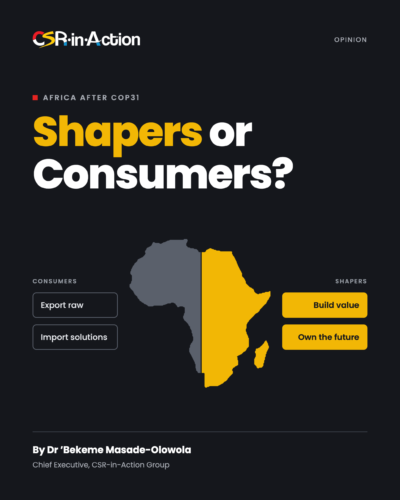
Why Africa’s next sustainability frontier will be defined by investment, competitiveness, resilience and the ability to turn climate ambition into economic value.
By Dr ’Bekeme Masade-Olowola Chief Executive, CSR-in-Action Group
The most consequential conversations at the annual United Nations Climate Change Conferences are not always those that produce the loudest applause. Sometimes, they are the difficult conversations about who pays, who benefits, who bears the risks and who ultimately gets to participate in the emerging global economy. For Africa, these questions matter more than most.
As the curtains fall on COP31 in Antalya, Türkiye, the continent must confront a fundamental question: are we positioning ourselves to shape the global sustainability economy, or are we preparing to become consumers of frameworks, technologies and financing arrangements designed elsewhere?
For Nigeria, this question carries particular significance. We are Africa’s most populous country, an important energy producer, a major consumer market and an economy with substantial untapped industrial potential. Yet we face persistent energy poverty, infrastructure deficits, climate vulnerability and significant constraints on affordable capital.
Our sustainability conversation must therefore extend beyond reducing emissions. It must address how we industrialise responsibly, create competitive enterprises, mobilise investment and improve livelihoods without repeating the environmental mistakes of earlier industrial economies.
The defining challenge for African business is no longer whether sustainability matters. It is whether we can make sustainability an engine of economic transformation.
COP31 and the limits of global consensus
COP31 was widely anticipated as an implementation-focused conference, with significant emphasis on adaptation, climate finance, energy transition, just transition and the measurement of progress under the Paris Agreement.
Yet after two days of overtime, it closed on 22 November without consensus on its proposed overarching agreement, the Antalya Pact. The European Union and several climate-vulnerable countries rejected a text that no longer referred to transitioning away from fossil fuels, while major producers resisted stronger language. For Africa, the losses were tangible: a proposed US$120 billion annual adaptation finance target was dropped from the drafts, a commitment to triple adaptation finance by 2035 was left without an agreed baseline, and an operational Just Transition Mechanism was deferred to COP32 in Addis Ababa.
For African businesses, the lesson is clear. The pace of commercial transformation cannot depend entirely on the pace of multilateral negotiations. International agreements remain essential for establishing shared expectations and mobilising cooperation, but businesses must make investment decisions, manage risks and pursue opportunities in real time.
The absence of diplomatic consensus does not eliminate climate-related risks. Neither does it reverse changes already taking place in international capital markets, industrial supply chains, technology adoption and corporate governance. Indeed, the distinction between political consensus and economic momentum may become one of the defining features of the next decade, and African enterprises must learn to operate confidently within it.
Climate finance must become an investment conversation
Perhaps no issue better illustrates Africa’s sustainability challenge than climate finance. Africa received about US$52 billion in climate finance in 2022, against estimated needs of US$190 billion, and much of it arrived as loans. Globally, the Baku to Belém Roadmap aims to mobilise US$1.3 trillion a year for developing countries by 2035, yet on current trends flows would reach only about US$460 billion.
These gaps matter. But we must pay equal attention to the conditions under which finance becomes accessible, and to the capacity of African institutions to absorb and deploy it productively.
A climate financing pledge is not the same as a bankable investment. Between the two lie project preparation, credible data, regulatory certainty, risk allocation, institutional capacity and commercially sustainable business models.
This is where African businesses must become more deliberate. We need enterprises capable of translating environmental and social challenges into investible opportunities across decentralised renewable energy, cleaner household cooking, climate-smart agriculture, industrial energy efficiency, waste recovery, sustainable transport and resilient infrastructure. These are not merely environmental interventions. They are markets, jobs, supply chains and sources of long-term economic value.
The capital to fund them is not only abroad. African pension funds hold more than US$1 trillion, and the African Development Bank estimates that ring-fencing a small share in the continent’s six largest economies could generate about US$70 billion a year, more than Africa currently receives in climate finance.
However, the private sector cannot carry the entire burden. Governments must establish predictable policies, development finance institutions must address genuine market failures, and commercial lenders must strengthen their ability to assess sustainability-linked investments.
At CSR-in-Action, our experience across corporate sustainability, stakeholder engagement and development initiatives continues to reinforce one principle: sustainable development becomes scalable when social value, institutional accountability and commercial viability reinforce one another.
Africa must move beyond seeking a larger share of global climate finance to building the institutional and commercial capacity required to deploy that finance effectively.
The energy transition must reflect African economic realities
One of the most persistent tensions in global climate discussions concerns the future of energy, and it was at the heart of the impasse in Antalya.
For industrialised economies with established electricity infrastructure, the energy transition is largely about transforming existing systems. For millions of Africans, it is also about obtaining reliable, affordable and modern energy in the first place. These are fundamentally different starting points.
Nigeria cannot pursue industrial competitiveness while manufacturers remain dependent on expensive self-generation. Nor can we speak meaningfully about an equitable transition without addressing households that continue to rely on polluting cooking fuels. For households still cooking with firewood and charcoal, LPG is a practical transition fuel: it cuts household air pollution and pressure on forests today, while cleaner options scale.
The appropriate response is neither to reject decarbonisation nor to embrace transition models that disregard our developmental circumstances. Africa requires credible, differentiated pathways that simultaneously expand energy access, improve efficiency, reduce avoidable emissions and support industrial growth.
This creates considerable opportunities for businesses. Distributed energy solutions can improve enterprise productivity. Cleaner cooking systems can strengthen household welfare and reduce exposure to harmful smoke. Industrial efficiency can lower operating costs. Circular business models can improve resource productivity while opening new markets.
Our work on the National Cylinder Recirculation Programme, unveiled at the Nigerian Pavilion at COP31, demonstrates the importance of connecting climate objectives with practical systems of delivery, including safety, product traceability, digital monitoring, responsible asset management and commercial participation. The broader lesson is that sustainability succeeds when it solves problems that people and businesses already experience.
Africa’s energy transition must be designed around development outcomes, not simply emissions accounting.
Sustainability is becoming a competitiveness issue
There was a time when corporate sustainability was treated largely as an extension of philanthropy or reputation management. That era is giving way to a more demanding commercial reality. Businesses are increasingly expected to understand their environmental exposure, manage supply-chain risks, demonstrate responsible labour practices and provide credible information about sustainability-related risks and opportunities. For Nigerian companies seeking international financing, export opportunities or a place in multinational supply chains, these expectations are now commercially significant.
The clearest signal is at home. Nigeria’s Securities and Exchange Commission is making reporting under the IFRS Sustainability Disclosure Standards, developed by the International Sustainability Standards Board, mandatory from 2027 for significant public interest entities, 2028 for other public interest entities and 2030 for smaller entities. Companies were asked to submit their adoption plans by 15 October 2026, and phased assurance requirements are being developed with the Financial Reporting Council.
The standards ask companies to connect sustainability-related financial risks and opportunities with governance, strategy, risk management, metrics and targets. This matters because sustainability information is increasingly relevant to decisions about enterprise value, capital allocation and business resilience.
For African businesses, the opportunity is to strengthen internal decision-making rather than approach disclosure merely as another compliance obligation. A manufacturer that understands its energy intensity can identify opportunities to reduce costs. A bank that assesses climate exposure across its loan portfolio can improve risk management. An agricultural exporter that understands its supply-chain vulnerabilities can protect market access and improve continuity.
The challenge is particularly important for small and medium-sized enterprises, which may lack the technical resources to respond to increasingly sophisticated expectations from financiers and major customers. Larger companies therefore have a responsibility to support sustainability capacity across their value chains, and financial institutions, professional associations and regulators must make the transition practical and proportionate.
Sustainability reporting should be the evidence of better business management, not a substitute for it.
Africa must capture more value from its natural resources
Another important implication of the COP discussions concerns Africa’s position within emerging global industrial value chains. The continent possesses substantial reserves of minerals relevant to batteries, electricity networks and other clean technologies. It also has significant renewable energy potential, agricultural resources and a growing population capable of supporting new industries.
Yet resource abundance does not automatically translate into prosperity. Africa’s historical experience demonstrates the limitations of exporting raw materials while importing higher-value finished products. The global transition presents an opportunity to reconsider this economic structure: to develop local processing capacity, strengthen technical skills, attract responsible manufacturing investment and retain more value within domestic economies.
This ambition must be pursued alongside strong environmental governance and meaningful community participation. Industrialisation that creates economic value while degrading ecosystems, displacing communities or undermining livelihoods cannot credibly be described as sustainable. Our approach must therefore connect industrial policy with responsible resource governance, community development and long-term environmental stewardship.
The opportunity is not simply to supply the materials required for the world’s transition. It is to become an increasingly important participant in the industries that transition creates.
Adaptation belongs in the boardroom
Climate adaptation is frequently presented as a governmental or humanitarian responsibility. Antalya’s failure to agree an adaptation finance target reinforces that public money alone will not meet the need. Treating adaptation as someone else’s responsibility also overlooks its significance for business continuity.
Flooding, extreme heat, changing rainfall patterns, coastal erosion and disruptions to agricultural production can affect physical assets, workforce productivity, logistics, insurance costs and supply-chain reliability. For a business operating in Lagos, climate exposure may manifest through flooding, infrastructure disruption or property damage. For an agricultural enterprise, it may involve changing growing conditions and uncertain yields. For financial institutions, these physical risks can become credit, insurance and investment risks.
Adaptation should therefore form part of mainstream enterprise risk management. Boards must ask whether their organisations understand their physical climate exposures, whether infrastructure investments account for future conditions and whether business continuity arrangements are sufficiently robust.
Adaptation also creates commercial opportunities in resilient construction, water management, agricultural technologies, insurance innovation and climate information services. The companies that recognise it as both a risk-management discipline and a market opportunity will be better positioned to protect and create value.
The African sustainability profession must evolve
One of the less discussed implications of the global sustainability transition concerns the professionals and institutions expected to implement it. Africa needs more than sustainability advocates. We need professionals who understand finance, engineering, environmental science, regulation, social performance, governance, data systems and enterprise strategy.
The sustainability function must become increasingly interdisciplinary. Professionals must be able to engage boards on capital allocation, advise management on transition risks, evaluate the commercial implications of regulation and establish credible systems for measuring performance. With mandatory ISSB-aligned reporting arriving in 2027, the demand for these skills in Nigeria is immediate. It requires investment in education, professional standards, practical training and institutional collaboration.
It also requires a change in organisational culture. Sustainability cannot remain the exclusive responsibility of a small department tasked with preparing annual reports or coordinating community projects. Its effectiveness depends on integration across finance, procurement, operations, human resources, strategy and executive leadership.
In the years ahead, the strongest sustainability professionals will be those who can connect environmental and social outcomes with the economic realities of the organisations they serve.
From global discussions to African execution
COP31 has reinforced an uncomfortable reality: the world may agree broadly on the importance of climate action while remaining deeply divided over its financing, pace and distribution of responsibilities. Africa cannot afford to interpret these divisions as a reason for inaction. Instead, we must develop the capacity to pursue our own sustainability priorities with greater institutional confidence.
- For governments, this means strengthening policy coherence, regulatory credibility and the investment environment.
- For businesses, it means treating sustainability as a strategic consideration in capital allocation, operational efficiency, market development and enterprise resilience.
- For financial institutions, it means developing financing approaches that recognise both the risks and the commercial potential of Africa’s transition.
- For sustainability professionals, it means moving beyond advocacy and disclosure towards measurable organisational and developmental outcomes.
- For communities, it means ensuring that economic transformation translates into meaningful improvements in livelihoods, opportunities and environmental quality.
Having worked in the sustainability space long before it became a prominent feature of corporate strategy in Nigeria, I have witnessed the evolution of the conversation from corporate social responsibility to ESG, climate risk, sustainable finance and increasingly sophisticated disclosure expectations. Each phase has contributed something valuable. Yet the ultimate measure of our progress cannot be the sophistication of our terminology, the number of conferences attended or the volume of sustainability reports produced. It must be the quality of the businesses we build, the resilience of our economies, the opportunities we create and the lives we improve.
The next chapter of African sustainability will not be written exclusively in the negotiating halls of international conferences. It will be written in boardrooms where investment decisions are made, factories where resources are used more efficiently, financial institutions where capital is allocated, and communities where the consequences of development are experienced.
Next year, the world comes to Addis Ababa for COP32, an African COP. It will test whether our continent arrives not only with demands, but with investable solutions, credible institutions and businesses ready to lead.
Africa’s greatest opportunity is not merely to participate in the global sustainability transition. It is to shape that transition in ways that advance our own prosperity.
That is the responsibility before us. And it is a responsibility that neither our governments nor our businesses can afford to postpone.
Sources
- UN News: COP31 ends without climate pact
- allAfrica / Premium Times: COP31 collapses as nations disagree over fossil fuel transition
- Climate Action Network: reaction to COP31
- UNECA: Africa makes the case for a climate finance overhaul at COP31
- Zawya: Nigeria SEC pushes ISSB-aligned disclosures
- XBRL International: Nigeria asks companies to show their ISSB homework